
I was nine years old when a tick bit me on my family's farm near Yosemite, California.
I remember it clearly — a big bullseye rash spreading out from the bite. We didn't even find the tick itself until it had already been lodged there for at least a couple of days; my father finally pulled it out with his own tweezers. But this was a different era of awareness. We had no idea what Lyme disease even was, let alone that antibiotics given quickly could have changed everything that followed. So nothing was done. Life simply continued.
I want to tell you about the moment, years later, that made me understand exactly what that farm afternoon had actually cost me — because I think it's the moment so many of you reading this are living right now without realizing it.
The Doctor Who Told Me There Was Nothing to Be Done

I ended up at an alternative hyperthermia clinic in Germany — a place I'd gone to specifically because conventional medicine had already failed me. A doctor there looked at the trajectory my body was on and told me, without hesitation, that I would eventually lose the ability to walk, and that there was nothing to be done about it.
Sit with that for a second. Not a conventional doctor. A healer, in an alternative setting, telling a young woman her decline was simply her fate.
I proved him wrong.
I'm not going to pretend that sentence resolves neatly into a five-minute read. It took years. But I want to tell you what I found on the other side of that diagnosis, because I think it's some of the most important information almost no one with chronic Lyme is ever given.
Your Negative Test Doesn't Mean What You Think It Means

Here's something worth knowing if you've ever been told "your Lyme test was negative, so it's not Lyme": the CDC's own published data shows the standard two-tier antibody test catches only 30–40% of true infections during early illness. A 2026 evaluation of even the newest testing algorithms found initial sensitivity as low as 22%.
Read that again. A test that misses the majority of real cases is still, for most doctors, the entire basis for ruling Lyme out.
Why is it this bad? Because the test isn't looking for the bacterium itself. It's looking for your antibody response to it — a response that takes weeks to build, varies wildly between people, and can be actively suppressed by the very survival strategies this organism uses to hide from your immune system in the first place.
A Pattern I Can't Stop Seeing
In years of scanning bodies for a living, I have found active Lyme-related frequencies in an enormous number of people who have no memory of ever being bitten by a tick. Not a handful. A recurring, unmistakable pattern.
I've scanned people with a decade of treatment-resistant depression and unexplained joint pain who'd never once been screened for a tick-borne infection — and found a clear signature sitting quietly underneath the entire clinical picture. I've scanned people with progressive, MS-like neurological decline, extensively worked up by specialists, told their decline was simply the disease running its course — whose scans revealed exactly what no one had thought to look for.
If your intuition has been telling you there's more to your story than a clean panel suggests, I want you to trust that. It has been right far more often than testing alone would predict.
Why Most Lyme Treatment Fails — And It's Not the Reason You'd Guess

Borrelia burgdorferi, the bacterium behind Lyme, doesn't exist in just one form. It has three — an active, replicating form; a dormant, encapsulated cyst form; and a colonial biofilm form protected by its own self-secreted shield. Standard antibiotic protocols were built to fight the first form almost exclusively.
Which means the cyst and biofilm populations are left completely untouched. They wait. And when treatment stops, they're exactly why so many people relapse and are told, once again, that their body is simply broken in a way medicine can't fix.
This isn't fringe theory. Peer-reviewed research out of the University of New Haven has now confirmed Borrelia biofilm exists not just in lab cultures, but in actual infected human tissue. The science is catching up to something the Lyme-literate medical community has been saying for years: chronic Lyme is real, it behaves differently than acute Lyme, and it requires an entirely different strategy to actually clear.
The Piece Almost No One Talks About

Here's what I've found, over and over, that rarely makes it into any Lyme conversation at all: I have almost never scanned a chronic Lyme case where parasites weren't quietly present in the same terrain.
This isn't coincidence. A body fighting a chronic bacterial infection and a parasitic burden at the same time cannot fully commit its immune resources to either one. Parasites consume the same nutrients your immune system needs to actually mount a response against Borrelia. And both organisms — this is the part that changed how I treat Lyme entirely — hide inside the exact same biofilm architecture.
Clear the Lyme without addressing the parasites, and you've treated half the terrain. I don't know a single person who has achieved full, lasting clearance without addressing both at once.
What Actually Worked
I healed. Fully. The walking I was told I would lose, I still have. And I did it primarily through an herbal, multi-layered protocol — not the short antibiotic course conventional medicine offers as the whole answer. I hold a genuinely strong opinion here, one I don't soften for the sake of politeness: followed completely and consistently, targeting all three forms of this bacterium alongside the parasitic terrain surrounding it, herbs are more than powerful enough to clear chronic Lyme. I don't reach for antibiotics unless a situation is truly extreme.
I've spent years refining the exact protocol that took me there — which herbs address which form, in what sequence, at what dose, alongside which specific medical-grade supplements, and how to navigate the Herxheimer die-off reaction without it derailing you. It's more than I can respectfully fit into a single article, and it deserves to be given to you complete, not in fragments.
If any part of this has been quietly resonating with something in your own body — the fatigue no one can explain, the fog, the pain that moves, the sense that a clean test result was never the whole story — I've put the complete framework into a single in-depth guide: every tier of the protocol, the exact medical-grade formulations I use with my own clients, the co-infection map, the Herxheimer management plan, and everything I wish someone had handed me before I spent years finding it myself.
You don't have to take a doctor's prediction as your final answer either.
The Complete Protocol, If You Want It
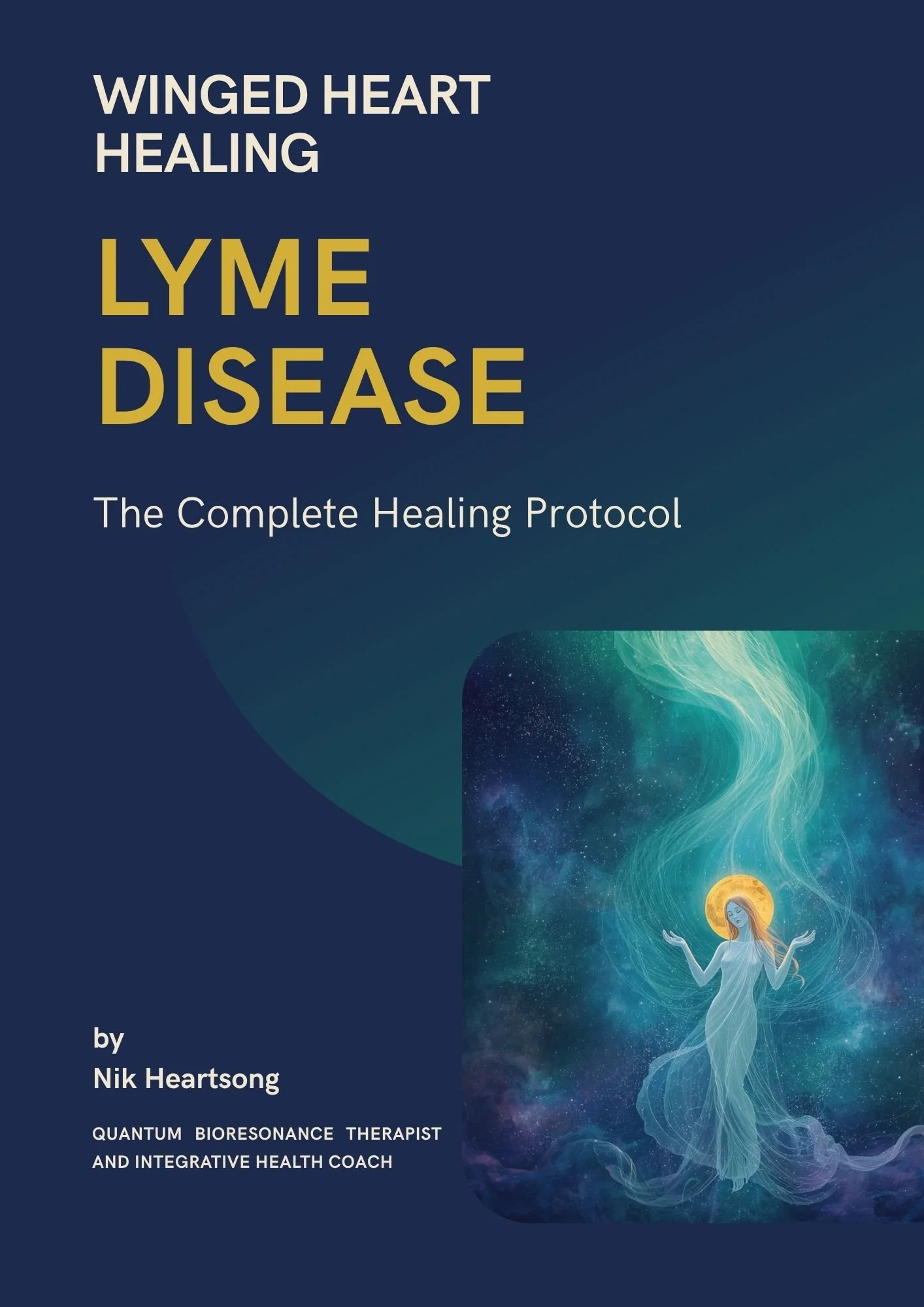
Everything I've described here is the why. The actual protocol — the exact herbs for each of the three Borrelia forms, the precise doses, the specific medical-grade brands I use with my own clients, the biofilm-disruption sequencing, the co-infection map, and a full Herxheimer management plan so die-off doesn't derail you — is more than I can responsibly compress into a single article.
So I didn't try to. I put the entire framework into one guide: The Complete Lyme Healing Protocol, a 22-page downloadable resource built from my own healing and refined across hundreds of client journeys since. It's the exact roadmap I wish someone had handed me instead of a prognosis.
You can also purchase the exact medical-grade supplements referenced in my complete Lyme healing protocol here, although I recommend booking a full bioresonance session with me before purchasing the supplements, so that we can look at exactly which strain of lyme you have and what the co-infections are (e.g. specific parasites or virus): https://us.fullscript.com/s/nheartsong/shop/plans/TXVsdGlQYXRpZW50UGxhbi0xNzcyOTI=
What a Bioresonance Scan Can Show You

If you've read this far, you may already suspect a blood panel was never going to be the whole story for you. This is exactly where a bioresonance scan becomes so valuable — it doesn't wait on a slow, unreliable antibody response the way conventional testing does. It reads your body's own frequency signature directly, which means it can pick up on active Borrelia strains, identify which specific co-infections are riding alongside it (Babesia, Bartonella, Rickettsia, and others each show up differently), and map exactly how deeply the infection has spread into your other body systems and organs — your liver, your lymph, your nervous system, your gut. Rather than a single yes-or-no answer, you get a full picture of what's actually happening in your terrain, which is precisely what makes it possible to build a protocol around your case specifically, instead of a generic starting point.
If you're ready to find out what your own body has been trying to tell you, I'd love to work with you directly.
Book your 90-minute bioresonance session here: https://calendly.com/heartsongvibes/90-min-bioresonance